
" The well-measured stop length "
" The missing link "
Wouldn’t Stradivarius have calculated the stop length as we are currently doing?
By making a violin, the term, stop length, refers to the distance between the top of the Belly and the nock of the f, which is 195 mm (AC) standard for the violin.

FIG. 1: AC, Stop length
Why does the scale (AC) measured from the top of the Belly differ according to the instruments?
This question has been bothering me for a long time, which is why we are examining it in this study.
In the study "Braccio Cremonese" (1), we put forward the idea that the basic module of the violin’s construction, i.e., the distance from the top to the bottom saddle (DB), is equivalent to
The Braccio Cremonese, the standard measurement system used at Stradivarius’ time, with the bridge placed at 2/3 of it. (FIG. 3 )
This measure is stable, so why, by Stradivarius, does the stop length when measured from the top of the belly vary according to the size of the instruments?
The stop length varies when measured from the top of the Belly, but the distance from the bridge to the bottom of the Belly remains constant.
Currently, the stop length (AC) measured from the top of the Belly to the f nock is 195 mm, based on an average measurement taken on Stradivarius' violins. But did he define the location of the bridge in that way?
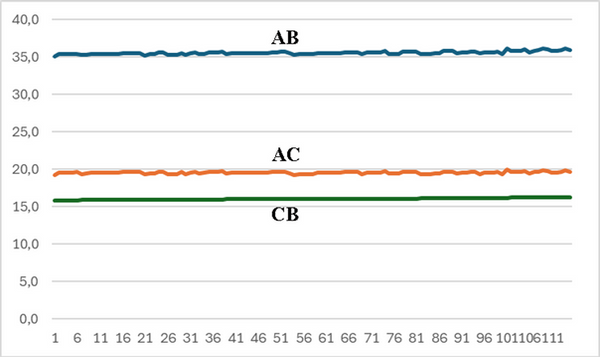
FIG. 2: CB = AB - AC
The stop length (AC) and the length of the Belly (AB) are mentioned by Jost Thöne. (2)
The measure CB is obtained here by subtracting AC from AB.
Of the 111 violins by Stradivarius studied here:
- The length of the Bellys varies from 347 to 362 mm (AB), a fluctuation that can reach up to 15 mm, while that of the vibrating string (DC), from the top to the bridge, remains constant.
- the stop length (AC) fluctuates, it increases or decreases in relation to the length of the Belly (AB). A shorter Belly will have a shorter stop length, and conversely a longer Belly will have a longer stop length. On the other hand, the bridge position, calculated relative to the bottom of the instrument (CB), remains stable.
Let’s take the example of a violin from the "longuets" period.
Length of the Belly AB 362 mm
Stop length AC 200 mm
Bottom of the Belly to the bridge CB 163 mm
CB 163 mm remains stable, while AC is 5 mm wider than the average measurement.

FIG. 3: 1 braccio, from saddle to saddle (DB), of which 2/3 for the vibrating string. (1)
The stop length (C) is located at 2/3 of the distance between the upper and lower saddle (DB) at 2/3 of the braccio, the standard measurement of the time (1).
This would mean that Stradivarius would have calculated the position of the bridge by taking the measurement from the lower saddle (CB), and this regardless of the length of the Belly (AB).
CB is equivalent to 4 ounces on 90% of the violins studied here. 4 ounces being the result of a simple division of the braccio.
Let's go back inside the instrument; 4 ounces are also found to be the top width of 10 Stradivarius moulds.
If we report the 4-ounce module outside the violin, from the bottom of the instrument, we find the location of the bridge (C).
4 ounces show us the missing link that allows us to go from the inside to the outside of the violin.
It’s the key that allows us to step out of the mould!
André Theunis
Brussels on April 14, 2026
Legal deposit Nr 2026/02072
Notary JADOUL, KESTELYN, GENICOT & DIERCKX
Notes:
1: André THEUNIS, Braccio Cremonese. Le Violon à la mesure de Crémone, Brussels, 2020.
https://www.wolf-tuner.com/cremona
2: Jost THÖNE, Antonius Stradivarius, Köln, 2010.